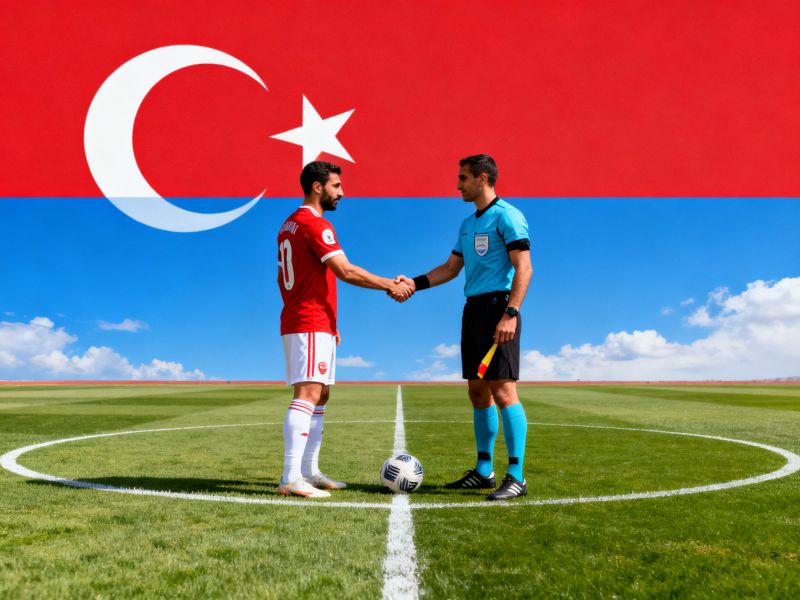
Ask a football fan to name a national derby and you'll hear the usual suspects: Brazil vs Argentina, Germany vs Netherlands, England vs Scotland. Ask about the most unfamiliar national derby and you'll get blank stares. That's the point. There is a derby so obscure, so geographically and politically tangled, that even seasoned supporters struggle to place it on a map. I'm talking about the rivalry between Armenia and Turkey—a fixture that has been played exactly once in the two nations' history, a 2009 World Cup qualifier in Bursa that ended 2-0 to Turkey. The return leg in Yerevan, a 1-0 Armenian win, remains the only other meeting. For a derby。that's almost nothing. Yet the weight of those two games could fill a library.What makes a national derby unfamiliar?Not lack of passion—Armenian and Turkish fans bring plenty of that, albeit often from a distance. It's the absence of shared sporting memory. There's no lore of legendary comebacks, no reel of iconic goals, no generational grudges passed down through terraces. The most unfamiliar national derby is unfamiliar because the political reality has kept the teams apart. The border between the two countries has been closed since 1993. Diplomatic relations don't exist. When the draw for the 2010 World Cup qualifiers paired them。it was treated as a diplomatic event as much as a sporting one. Presidents watched from the stands. Security was suffocating. Players later admitted they felt like actors in someone else's script.I watched both matches on a grainy stream in a friend's apartment in Berlin, surrounded by Armenians and Turks who had grown up in the same German city but had never once played football against each other. That's the strange part. Diaspora communities in Europe and North America have their own low-key derbies—amateur league games, community tournaments—but they're shadowboxing. The real fixture, the one that would matter, is locked behind a border. The most unfamiliar national derby is unfamiliar partly because its most natural audience can't attend. How do you build a rivalry without away fans?How do you create mythology when the protagonists meet twice a decade。
if that?There's another layer. The derby isn't just unfamiliar to outsiders;it's unfamiliar to the participants themselves. Armenian players of a certain age grew up knowing Turkish football only through satellite TV. Turkish players knew Armenia as a line on a political map. When they finally met on the pitch, there was no shared vocabulary of rivalry—no chants to trade, no history of provocation. Just awkward respect. After the Yerevan match, Turkish goalkeeper Volkan Demirel embraced his Armenian counterpart. It was a small gesture that felt enormous. You don't see that in a Clásico. You see it in a derby that's still figuring out what it is.Will it ever become familiar?Maybe not in my lifetime. But the most unfamiliar national derby deserves attention precisely because it refuses to be a spectacle. It's a rivalry without highlight reels, a grudge without a scoreboard. If you ever get the chance to watch these two teams play—assuming politics allows it—don't expect fireworks. Expect a strange。
quiet intensity. Expect players who know they're carrying more than a game. And expect to feel, just for a moment, that you're watching something you don't quite understand. That's the definition of unfamiliar. And honestly。it's more interesting than another Brazil-Argentina rerun.